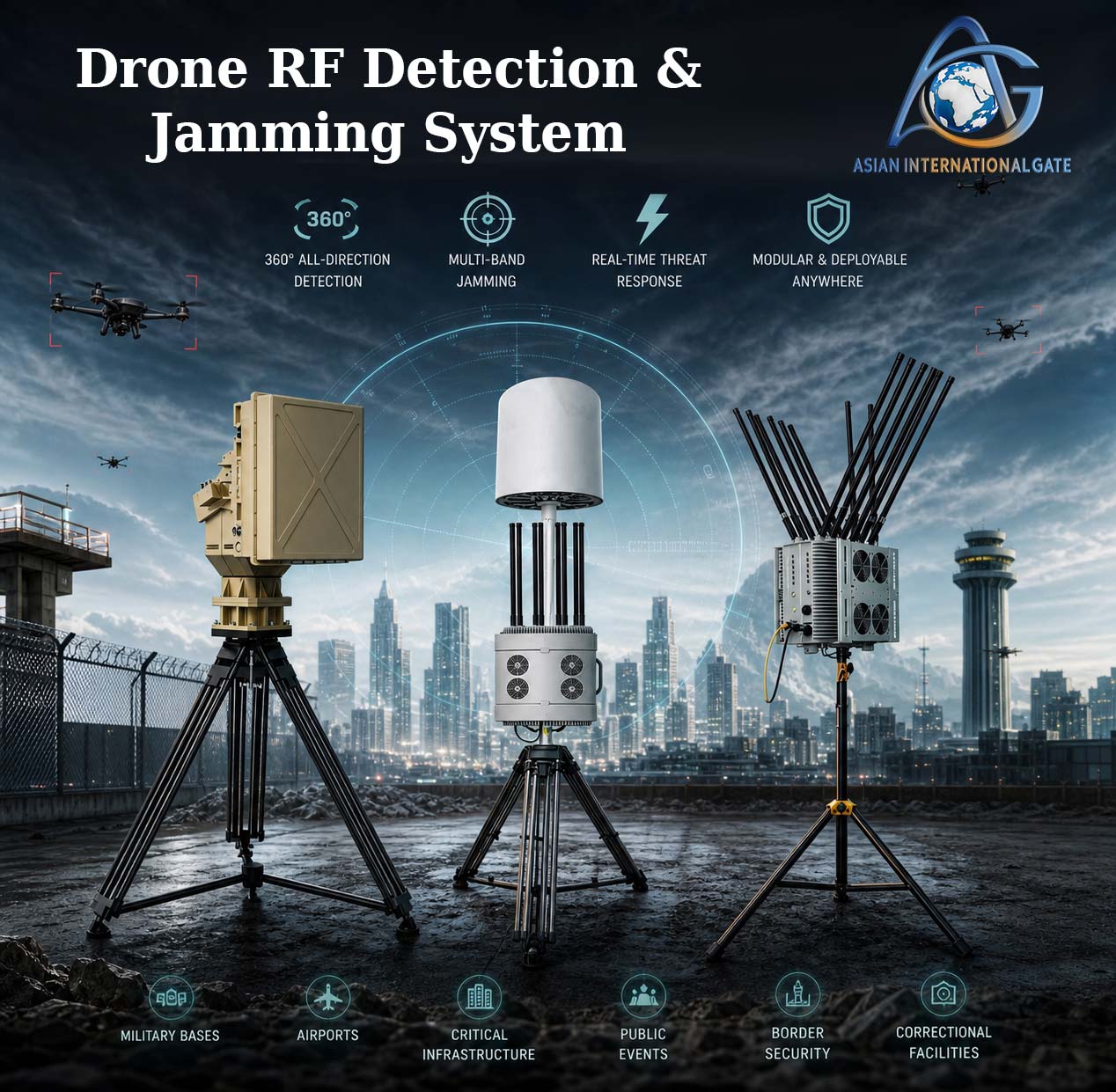
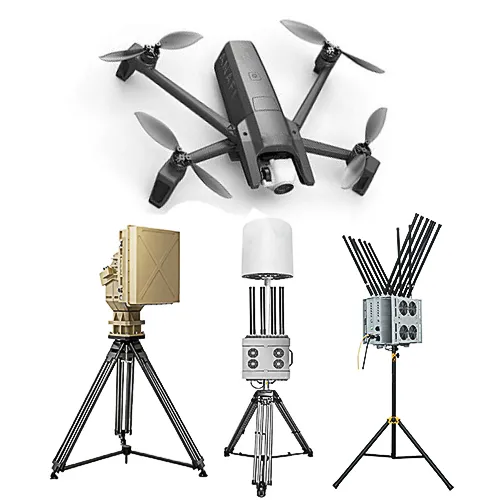
Drone RF Detection and Jamming System
Drone RF Detection and Jamming Systems are integrated systems for countering drones through detection and jamming technologies. They work by detecting radio frequency signals to locate and control the aircraft, and then jamming to disrupt communication between the aircraft and the operator. They are used to protect vital facilities, convoys, and military areas from espionage threats or small air attacks. They are characterized by their ability to integrate radar and sensors to provide comprehensive coverage and an immediate response against threats.
|
|
||
|
Drone RF Detection and Jamming System |
||
|
|
||
|
DESCRIPTION |
||
|
This system is a ground-based fixed drone detection and jamming station designed to protect sensitive airspace by identifying and neutralizing unauthorized Unmanned Aerial Vehicles (UAVs). |
||
|
Key Features |
||
|
Full Frequency Band Detection: |
70MHz-6GHz scanning, covering all commercial and customized drones, including DJI drones and Auel drone, FPV drone. |
|
|
Superior Jamming Performance: |
13 default jamming frequency bands, effective against RF-controlled, FPV, and non-standard frequency drones. |
|
|
Multiple Interference Modes: |
Omnidirectional and directional jamming to counter various threats. |
|
|
Scalable Architecture: |
Supports integration with radar, optoelectronics, and navigation deception systems; enables 1+N distributed deployment. |
|
|
Unattended Operation: |
Automatic, intelligent execution of preset defense plans with remote device control. |
|
|
Military-Grade Build: |
Aviation aluminum shell, resistant to extreme temperatures and harsh environments. |
|
|
Signal Collection: |
Built-in capability to collect and analyze unknown drone signals. Customizable Solutions: Tailored defense strategies for different customer needs. |
|
|
Visual Control System: |
Large-screen visualization, real-time alarms, multi-mode attack switching, and multilingual support. |
|
|
Key Components & Capabilities |
||
|
RF Detection Module: |
Uses passive radio frequency sensors to scan the electromagnetic spectrum (typically from 70 MHz to 6 GHz) to identify unique communication signals between a drone and its operator. |
|
|
Multi-Band Jamming: |
Once a threat is detected, the system emits high-powered radio energy on common frequencies (like 2.4 GHz, 5.8 GHz, and GNSS/GPS bands) to disrupt the drone's control and navigation links. |
|
|
Automatic Response: |
These fixed installations often support an "unattended mode," where they can autonomously detect and strike rogue drones 24/7 without manual intervention. |
|
|
Weatherproof Design: |
Housed in durable, military-grade (IP65/IP66 rated) Enclosures; these systems are built to operate in harsh outdoor environments, from extreme heat to freezing temperatures. |
|
|
Typical Operational Outcomes |
||
|
When the jamming is triggered, it typically forces the drone into a failsafe protocol, resulting in: |
||
|
1. Return to Home (RTH): The drone flies back to its original launch point. |
||
|
2. Controlled Landing: The drone lands safely in its current position. |
||
|
3. Hovering: The drone remains in place until its battery is depleted. |
||
|
MAIN TECHNICAL PARAMETERES |
||
|
Drone detection range |
Up to 10 km |
|
|
RF frequency detection |
In 360° |
|
|
Frequency bands for detection and jamming |
433 MHz 915 MHz All types of navigation satellite bandwidths 2400-2500 MHz 5800 MHz Option for other frequency bands |
|
|
Jamming system output RF power |
Depending on the end user requirements |
|
|
Installation |
Depending on the end user requirements |
|
|
Type of jamming system antennas |
Directional and/or omnidirectional antennas |
|
|
|
||