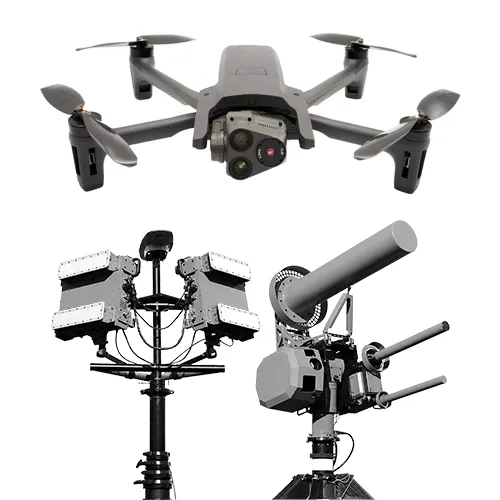
ANTI DRONE SYSTEMS
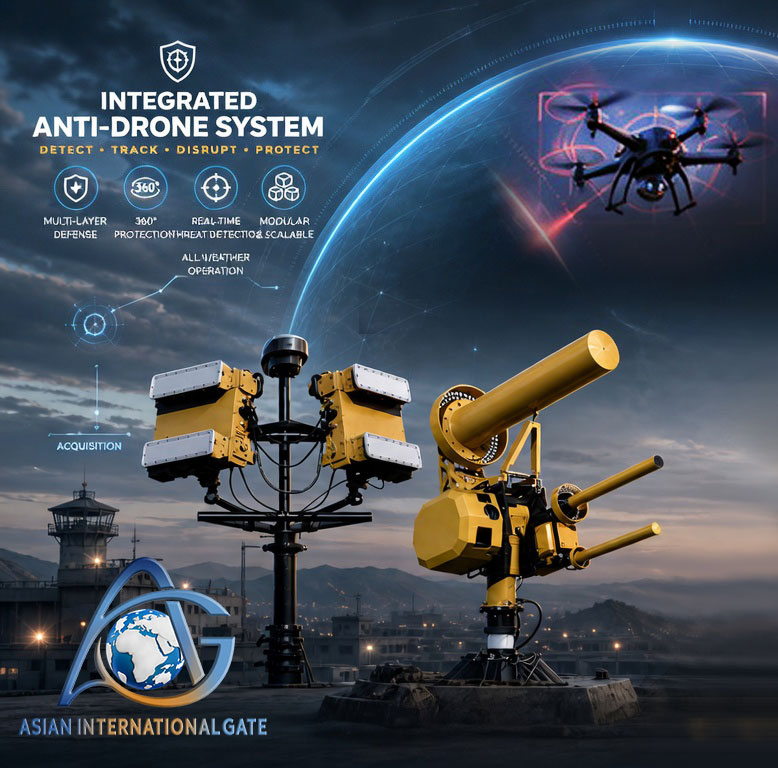
Anti-drone systems are specialized defense systems to counter unmanned aerial vehicles (UAVs). They work by integrating early detection radar technologies, jamming to disrupt communications, and sometimes lasers or projectiles to bring down the target. They are used to protect vital installations, convoys, and military areas from espionage threats or small air attacks. They are characterized by their ability to operate in a stationary or mobile manner, with wide coverage and immediate response against modern aerial threats.
|
|
|
ANTI DRONE SYSTEMS |
|
|
|
DESCRIPTION |
|
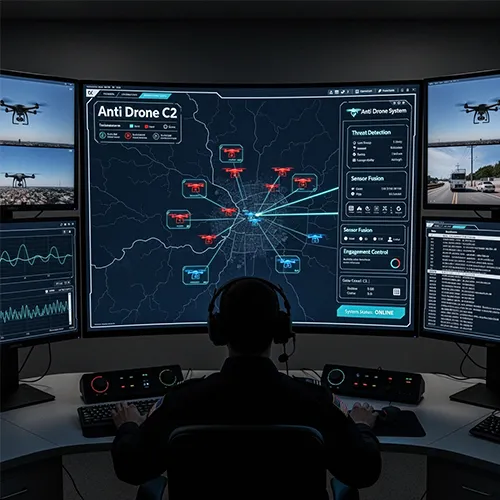
Anti-drone systems, also known as counter-UAS (C-UAS) technology, are integrated solutions designed to detect, identify, track, and neutralize unauthorized or hostile unmanned aerial vehicles (UAVs). These systems typically operate in three stages: detection, threat assessment, and neutralization. |
|
Key Features of this System |
|
Core Functions of Anti-Drone Systems |
|
Detection & Tracking: |
|
Various sensors find rogue drones and provide situational awareness. |
|
Radar: Uses radio waves to track distance and position; specialized C-UAS radar can distinguish small drones from birds. |
|
Radio Frequency (RF) Analyzers: Passively detect communications between a drone and its controller to identify models or even MAC addresses. |
|
Optical/Infrared Sensors: Cameras provide visual confirmation and can track thermal signatures from motors and batteries, even at night. |
|
Acoustic Sensors: Microphones identify the unique sound signatures of drone propellers, making them effective for detecting autonomous drones that do not emit RF signals |
|
Neutralization (Soft-Kill vs. Hard-Kill): |
|
Soft-Kill (Non-Kinetic): Disruption techniques like RF jamming, which drowns out control signals; GPS spoofing, which tricks a drone into thinking it's elsewhere; or cyber takeovers, which hack and assume control of the UAV. |
|
Hard-Kill (Kinetic): Physical destruction or capture using net guns, directed energy weapons (lasers or high-power microwaves), projectiles, or even interceptor drones designed to ram or capture the target. |
|
Integrated Anti-Drone System |
|
- Option for stationary and mobile application and installation |
|
- System design conforms to military standards |
|
- Minimum installation time for stationary and mobile variants |
|
Main Mission |
|
- RF detection of the uplink and downlink communication links between drones and their remote-control stations |
|
- Detection at long distances (up to 10 km) at 360° |
|
- Detection of multiple drones simultaneously at 360° (swarm detection) |
|
- Tracking and recording of detected drones |
|
- Historical logs of detected drones |
|
- Jamming of the uplink and downlink communication links between drones and their remote-control stations and jamming of the GNSS signals. |
|
The results are as follows |
|
a) Drone will stop flight and return to home position (or other predefined position) |
|
b) Drone will stop flight and land at the position where GNSS information is lost due to jamming |
|
|