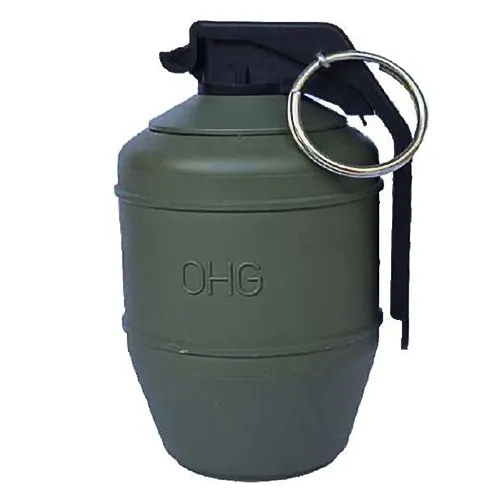
OHG OFFENSIVE HAND GRENADE
The OHG is an offensive hand grenade designed for close-combat operations. Featuring a compact cylindrical body with a safety lever and pull ring, it is filled with high explosive to deliver a powerful blast effect with minimal fragmentation. Ideal for use in enclosed spaces, bunkers, and urban combat, the OHG provides reliable destructive capability while reducing collateral risk to friendly forces.
|
|
||
|
OHG OFFENSIVE HAND GRENADE |
||
|
|
||
|
DESCRIPTION |
||
|
The OHG offensive hand grenade has been designed to defeat enemy manpower through fragmentation and high-explosive action. Fragmentation is achieved by ready-made striking elements with a small weight and a small radius of impact. The shock wave resulting from the explosion of this grenade has a higher pressure than the shock wave resulting from the explosion of a defensive grenade. For this reason, the grenade is particularly effective when operating in closed or semi-closed spaces - bunkers, trenches, etc. |
||
|
The grenade has two levels of safety - a pin that holds the lever and makes it safe for storage and transportation, and the lever itself, which holds the striker until the grenade is thrown. The time delaunch from the moment the lever. |
||
|
Design and purpose |
||
|
Offensive Role: |
Unlike "defensive" grenades (like the F-1), which have a large lethal radius and require the thrower to be behind cover, the OHG is an offensive grenade. It relies on a smaller, controlled blast and approximately 750 preformed cylindrical fragments to eliminate targets in open terrain or trenches without endangering the advancing soldier. |
|
|
Mechanism: |
It uses a standard striker-release system. Once the safety pin is pulled and the lever is released during the throw, a spring-loaded striker hits a percussion primer, igniting a pyrotechnic delay that leads to detonation. |
|
|
Training Variant: |
A practice version, is also produced for training purposes to simulate the weight and handling of the live grenade. |
|
|
TECHNICAL INFORMATION |
||
|
Grenade type |
Offensive |
|
|
Type |
Hand Grenade fragmentation |
|
|
Diameter |
60 mm |
|
|
Height |
110 mm |
|
|
Weight |
0.450 kg |
|
|
Remote arming time of fuze |
4 sec ± 0.5 sec |
|
|
Weight of TNT |
104 g |
|
|
Explosive |
TNT |
|
|
Diameter of fragmentation |
1.8 mm |
|
|
Operating temperature |
from -43°C to +52°C |
|
|
Impact radius with probability 50% |
5 m |
|
|
Type of fuze |
ED-4S |
|
|
Safety radius |
20 m |
|
|
Safe drop height |
3 m |
|
|
Shelf life |
10 years |
|
|
DHG vs. OHG: The Main Differences |
||
|
The primary difference lies in their tactical use and body design: |
||
|
Fragmentation (Defensive): The DHG has a thick, segmented body designed to shatter into large, heavy fragments upon detonation. Because its lethal radius is larger than the distance an average soldier can throw it, it must be thrown from behind cover (like a trench or a wall). |
||
|
Concussion (Offensive): The OHG has a smooth, thinner body. It relies on blast pressure and smaller fragments to clear an area, allowing advancing soldiers to throw it while in the open without being hit by their own grenade's shrapnel |
||
-001_1782819871.webp)