GNSS JAMMERS
GNSS JAMMERS systems are jammers designed to disrupt signals of global navigation systems such as GPS, GLONASS, Galileo and BeiDou. They emit powerful waves that cover the frequency bands of satellites, resulting in loss or weakening of positioning accuracy. They are commonly used in military and security operations to prevent reliance on satellite navigation in drones or vehicles. They are characterized by their ability to jam in wide ranges, with the possibility of being carried or mounted on vehicles depending on the nature of the mission.
|
|
||
|
GNSS JAMMERS |
||
|
|
||
|
DESCRIPTION |
||
|
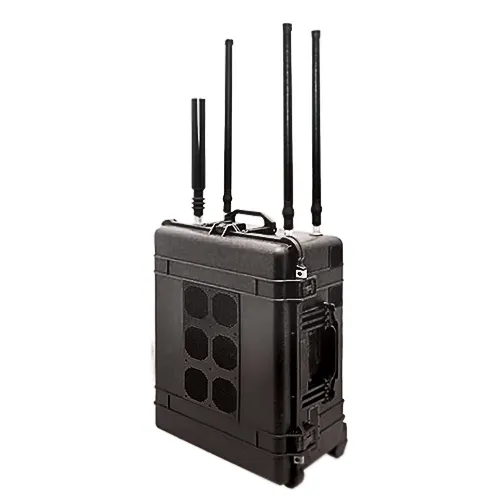
The device is a portable GNSS (Global Navigation Satellite System) drone signal jammer, specifically the UADS 10-22 (Universal Anti-Drone System). |
||
|
GNSS jammers may be manpack, portable, stationary, and mobile. The device may jam all types of navigation satellite bandwidths (L1, L2, and L5 bands), including all navigation satellites (GPS, Galileo, GLONASS, BeiDou, and others). |
||
|
The jammer's RF output power is determined according to the end user's requirements. The type of antennas is also determined according to the end user's requirements |
||
|
Key Features of this System |
||
|
These units are typically designed for rapid deployment in high-security or military environments to create a "no-fly" or "no-signal" zone. |
||
|
Suitcase/Trolley Design: |
The ruggedized "pelican-style" case allows for extreme portability and includes a built-in battery for field operation. |
|
|
Multi-Band Jamming: |
It targets critical communication and navigation frequencies, including: |
|
|
GNSS Bands: Disrupts GPS, GLONASS, Galileo, and BeiDou to prevent satellite-based positioning. |
||
|
Control Frequencies: Overpowers the 2.4GHz and 5.8GHz bands used by drone operators to control their aircraft |
||
|
Telemetry/Video: Blocks the downlink signals that send video and flight data back to the pilot. |
||
|
Omnidirectional Defense: |
The four prominent antennas provide a 360-degree protective bubble, with jamming ranges often reaching between 1,000 and 2,000 meters depending on conditions. |
|
|
Typical Applications |
||
|
Military Operations: |
Protecting infantry convoys or temporary outposts from surveillance or RCIEDS (Radio-Controlled Improvised Explosive Devices). |
|
|
VIP Protection: |
Ensuring personal privacy and safety in public spaces. |
|
|
Critical Infrastructure: |
Securing airports, prisons, or government buildings from unauthorized drone entry. |
|
|
MAIN TECHNICAL PARAMETERES |
||
|
RF Power |
According end user requirements |
|
|
Antenna types |
• Omnidirectional • High gain directional |
|
|
Installation |
According end user requirements |
|
|
|
||